Managing Variability Without Losing Stability
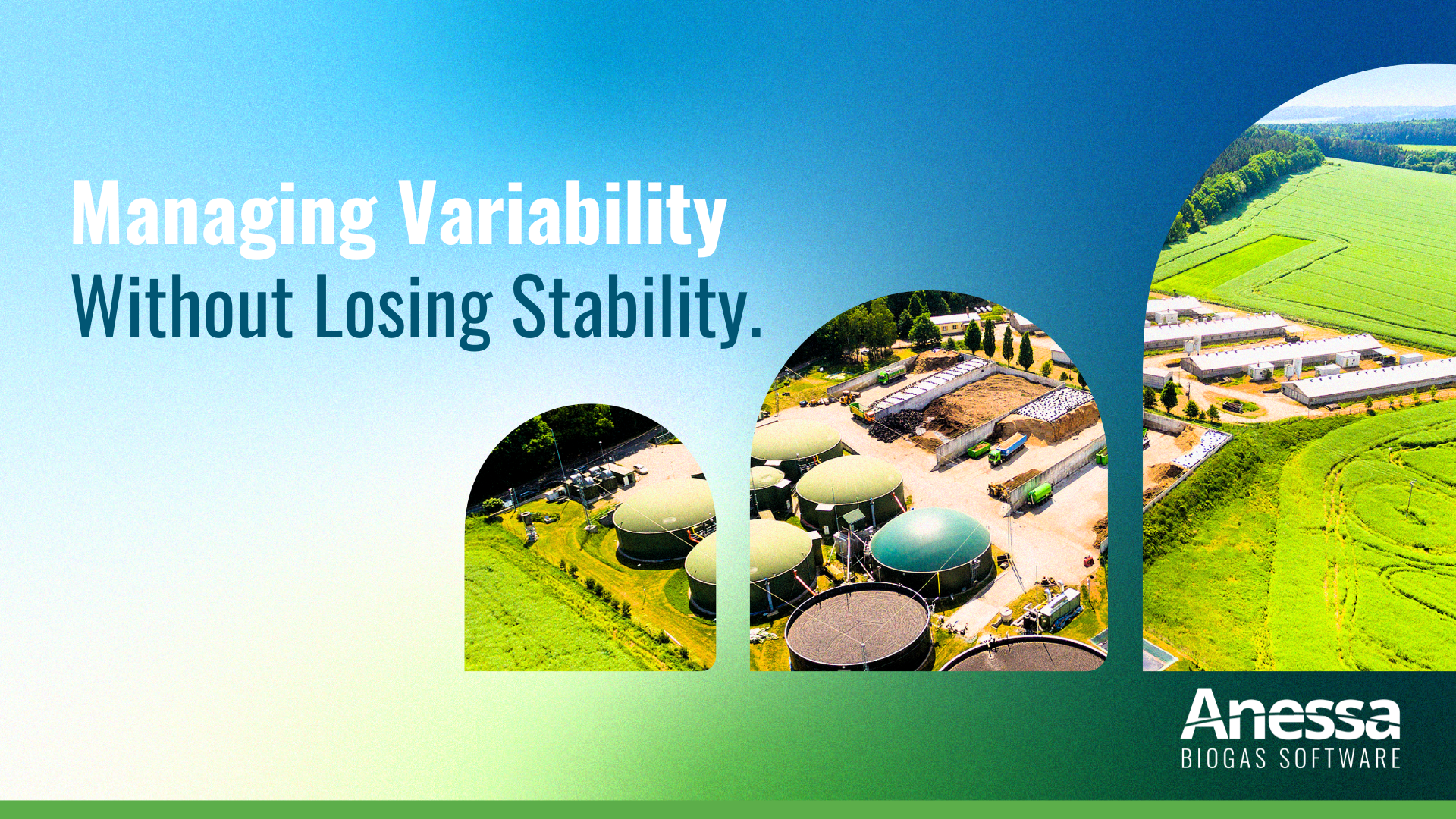
Operating AD Plants in a World of Constant Change
One of the biggest misconceptions in anaerobic digestion is the idea that plants operate under stable conditions. On paper, feedstock assumptions often look clean and predictable. In reality, most operators know that very little stays constant for long.
Feedstocks change. Seasons shift. Suppliers vary. Moisture content moves up and down. Organic composition changes week to week and sometimes day to day. Even small variations in TS, VS, nutrient balance, or contaminants can ripple through the digestion process in ways that are difficult to predict.
And the biology inside the digester has to absorb all of it.
However, Variability is not just a biological challenge; it is a constrained optimization problem. Every incoming tonne of feedstock activates trade-offs across gas yield, biological risk, logistics cost, and carbon intensity simultaneously. Managing those trade-offs manually, across a portfolio of plants, is no longer realistic.
At Anessa AI, this is one of those biogas production challenges that we spend the most time thinking about. Because variability is no longer occasional. It has become part of the normal operation of biogas plants. The question is no longer how to avoid it. The question is how to manage it without losing stability.
Variability Has Become Structural
A decade ago, many plants were designed around relatively fixed assumptions. Operators often relied on consistent feedstock streams with limited fluctuation over time.
That environment has changed.
Today, feedstock availability is influenced by policy incentives, transportation costs, seasonal agricultural cycles, waste diversion programs, shifting market economics and even geopolitical uncertainties. Operators are increasingly blending multiple substrates just to maintain supply security and economic viability. What most operators are not yet doing is optimizing across both dimensions at once, selecting substrates not only for their biological fit, but for their delivered cost and carbon footprint. As CI calculations become tighter, the origin and transport of every tonne start to matter as much as what it contains.
That flexibility creates opportunity, but it also introduces complexity.
A feedstock that performs well one month may behave very differently the next. Seasonal manure characteristics change. Food waste composition fluctuates. Energy crop residue varies depending on weather conditions and harvest quality.
The biology inside the digester experiences all of these shifts directly.
What makes this particularly challenging is that biological instability rarely happens all at once. It tends to build gradually.
A slight accumulation of VFAs.
A subtle reduction in methane quality.
Foaming that appears inconsistently.
Longer recovery periods after feedstock adjustments.
Operators often notice the symptoms before they fully understand the cause.
Stable Plants Are Not Necessarily Static Plants
The most resilient AD plants are not the ones operating under perfect conditions. They are the ones that are prepared for changing conditions.
That distinction matters.
Trying to eliminate variability completely is unrealistic in today’s market. Stability comes from understanding how much variability the biology can tolerate and how quickly the system can adapt.
In practice, that means operators are constantly balancing competing priorities:
Maximizing gas production
Maintaining stable biology
Managing feedstock costs
Meeting CI targets
Reducing operational risk
Every feedstock decision becomes part technical, part biological and part financial.
The challenge is that these priorities do not resolve themselves naturally. Maximizing gas yield can increase inhibition risk. Minimizing feedstock cost can compromise biological stability. The multi-objective optimization allows the platform to map the full solution space and surface the combination that best balances all objectives under the plant’s current operating constraints without defaulting to trial and error.
This is where predictive tools are starting to change how plants operate.
Staying Ahead of Instability
Historically, many plants have operated reactively. A parameter moves outside its range, an alarm triggers and operators respond.
The challenge with biology is that by the time alarms appear, stress has often been building in the system for days.
That delay can be expensive.
Biological instability affects much more than gas production. It impacts energy consumption, operational efficiency, maintenance requirements, and long-term equipment health. Chronic instability can slowly reduce plant performance without creating a single catastrophic event.
What operators increasingly need is visibility before instability fully develops.
This is where Anessa’s platform was designed to help.
With our simulation module, operators can simulate feedstock blends before introducing them into the plant. Different substrate combinations can be evaluated not only for gas yield potential, but also for biological impact and operational risk. The simulation validates a recipe against three layers simultaneously: biological feasibility, equipment capacity constraints, and current inventory levels. A blend that looks optimal on paper but exceeds the digester’s hydraulic throughput or outpaces available stock will be flagged before it becomes a problem.
Instead of relying purely on historical assumptions, teams can start asking more forward-looking questions:
How will this feedstock affect digestion stability over time?
Could this blend increase inhibition risk?
What happens to methane production if moisture content shifts?
How sensitive is the biology to seasonal variability?
That level of planning changes the conversation from reaction to anticipation.
Understanding Biological Tolerance Corridors
One of the more important concepts in modern AD operations is understanding biological tolerance corridors.
Digesters are not fragile systems, but they do have operational boundaries. Biology can absorb variability up to a point. Problems begin when changes happen too quickly, too frequently, or without enough visibility into the system response.
The challenge is that those boundaries are rarely fixed.
They shift depending on:
Feedstock composition
Loading rates
Temperature conditions
Nutrient balance
Existing microbial health
This is why relying on static assumptions often creates problems over time.
At Anessa, a major part of the focus has been building tools that reflect the dynamic nature of AD operations. Through the simulation module, project developers can evaluate how different plant designs and feedstock strategies may behave under changing real-world conditions long before commissioning begins.
That matters because operational resilience often starts during the design phase.
Designing around averages may work temporarily. Designing around ranges and variability creates plants that are far more adaptable over a 20-year lifecycle.
The Role of Real-Time Visibility
Even with strong planning, conditions continue to evolve once a plant is operational.
This is where monitoring becomes critical.
Most plants already collect large amounts of operational data. The challenge is turning that data into meaningful insight before instability escalates.
With our monitoring module, Anessa helps operators bring together sensor data, historical trends, and operational metrics into one connected view of plant performance.
Two specific capabilities shine through with this module:
Monitoring Solution: the Dynamic PFD, a real-time visual Process Flow Diagram showing the live status of all equipment (digesters, pasteurization units, upgraders), flow directions, temperatures, pressures, and volumes across minute/hour/day timeframes.
Downtime Financial Impact tool: it cross-references operational stops (e.g., flare activation, upgrader failure) with current energy prices to immediately quantify revenue loss. This is the difference between knowing something stopped and knowing it costs.
The goal is not simply to collect more data. Operators are already overwhelmed with information in many facilities.
The real value comes from identifying patterns that may otherwise go unnoticed:
Early biological drift
Gradual performance decline
Unusual energy consumption trends
Feedstock-related instability patterns
Often, the earliest signs of instability are subtle. A single parameter may not appear problematic on its own, but several small deviations together can tell a much larger story.
This is where Anessa become incredibly valuable. They help operators see relationships across the system instead of isolated data points.
The Financial Side of Stability
Biological stability is sometimes viewed as purely an operational concern. In reality, it has direct financial implications.
A plant dealing with chronic instability often experiences:
Reduced methane yield
Increased parasitic energy demand
Higher chemical usage
More downtime
Faster equipment wear
Reduced operational efficiency
These costs rarely appear all at once, which makes them easy to underestimate.
Over time, though, they affect the overall economics of the facility.
Stable biology supports more predictable production, lower operational stress and better long-term asset performance. CI Score simulator and optimization constraints alongside financial metrics maximize carbon credit revenues, meaning that stable, well-managed feedstock blends don’t just protect uptime; they directly increase the value of environmental credits. That consistency also becomes increasingly important for RNG projects tied to CI performance, compliance requirements and long-term offtake agreements.
In many ways, operational stability becomes part of the plant’s commercial strategy.
Adaptability Is Becoming a Core Capability
As the industry evolves, plants will continue facing more variability, not less.
Feedstocks will diversify further. Regulations will tighten. Market conditions will continue shifting. Operators will be expected to manage increasing complexity while maintaining performance and reliability.
That reality is reshaping how successful plants operate.
The facilities performing best over time are often the ones with the strongest ability to adapt. Not through constant reactive intervention, but through better visibility, better planning and better decision-making.
This is exactly where Anessa’s suite of products is positioned. This is exactly where Anessa’s suite of products is positioned. Specifically, the Logistics Network Optimizer minimizes total supply chain costs and emissions by optimizing transportation routes, sourcing locations, and delivery schedules across multi-source, multi-destination networks, including reducing empty truck runs and improving fleet utilization. This is adaptability at the supply chain layer, not just the biology layer.
Adaptability at scale also requires more than better tools in individual plants. It requires a connected view across the entire operation from substrate sourcing and logistics through biological monitoring and financial performance in one system that connects and consolidates SCADAs, spreadsheets, and siloed lab reports that most portfolios still rely on and drive meaningful results from them.
From feasibility and design through operational optimization and monitoring, the focus remains the same: helping plants operate with more confidence in uncertain conditions.
Closing Thoughts
Variability has become part of modern AD operations. The plants that succeed long term will not be the ones chasing perfect conditions. They will be the ones prepared to operate effectively through changing conditions.
Maintaining stability today is less about eliminating change and more about understanding how to navigate it before problems begin to surface.
And increasingly, that comes down to having the right visibility, the right tools, and the ability to make smarter decisions before instability takes hold.