Risk, Revenue and Long-Term Contracts
How Smarter Operations Strengthen RNG Offtake Agreements
In the renewable natural gas market, long-term value is rarely defined by production alone. What matters just as much, if not more, is how reliably that production shows up over time.
At Anessa, this is something we see across projects at different stages. Our modules focus not only on improving output, but on building that level of operational consistency that strengthens commercial agreements. Because in today’s market, stronger operations often translate directly into stronger contracts.
What Buyers Are Really Looking For
When people talk about RNG projects, the conversation often starts with volume. How much gas can a plant produce? How quickly can it scale?
Those are important questions, but they aren't the only ones buyers ask.
Offtake partners are looking for something deeper. They want confidence.
They want to know the gas they contract today will be delivered consistently over the life of the agreement. They want assurance that the quality will meet specifications, that reporting will hold up under scrutiny and that the environmental attributes tied to that gas will remain intact.
In other words, they are buying reliability.
That reliability shows up in a few key ways:
Consistent delivery profiles
Stable gas quality that meets pipeline or end-use requirements
Transparent and verifiable documentation
Confidence in carbon intensity performance over time
These factors shape how contracts are structured, how risk is priced and how long-term relationships are built.
Where Operational Risk Starts to Show Up
Even well-designed plants can face variability once they are up and running. Feedstock supply changes, seasonal shifts, equipment wear and biological fluctuations all influence performance.
Over time, these variations can start to affect commercial outcomes.
A missed delivery window may not seem significant in isolation, but repeated inconsistencies can erode trust with offtake partners.
Fluctuations in gas quality can trigger penalties or require additional processing.
A digester process upset can cost anywhere between 30,000 and 100,000 euros per week in lost production and recovery time. For a plant under an offtake agreement, that is not just an operational event. It is a contractual exposure. Early warning systems that reduce this risk by 80% change the risk profile that buyers and lenders are actually underwriting.
Gaps in documentation or emissions tracking can raise compliance concerns, particularly in markets where carbon accounting is closely monitored.
And when carbon intensity performance drifts from expectations, it can affect the value of associated credits or even lead to clawbacks.
None of these issues happen overnight. They build gradually, often starting with small operational deviations. But once they begin to impact contractual obligations, they shift from being operational challenges to commercial risks.
Our platform's data quality check system continuously evaluates data completeness, flagging frozen sensors, missing tags, and implausible values in real time. For offtake partners and verifiers, that means the data supporting a CI score or compliance report has been continuously validated, not assembled at the last minute.
The Link Between Operations and Revenue
There is a direct connection between how a plant operates and how it performs commercially.
A facility that runs with stable digestion, predictable output and consistent gas quality is easier to contract. Buyers are more willing to commit to longer-term agreements when they have confidence in delivery.
That confidence often translates into stronger contract terms.
On the other hand, plants that show variability may find themselves operating under more conservative agreements. Buyers may build in stricter conditions, shorter contract durations, or pricing structures that reflect higher perceived risk.
Over time, this affects revenue stability.
It also influences how investors view the asset. Predictable performance supports valuation. Uncertainty tends to do the opposite.
This is where the conversation around operations becomes more strategic.
A biogas asset with an auditable Digital Twin performance record carries a measurably higher resale and refinancing value. For investors and lenders, a documented operational history is a de-risking factor. It replaces projected performance assumptions with actual tracked data across the asset's operating life.
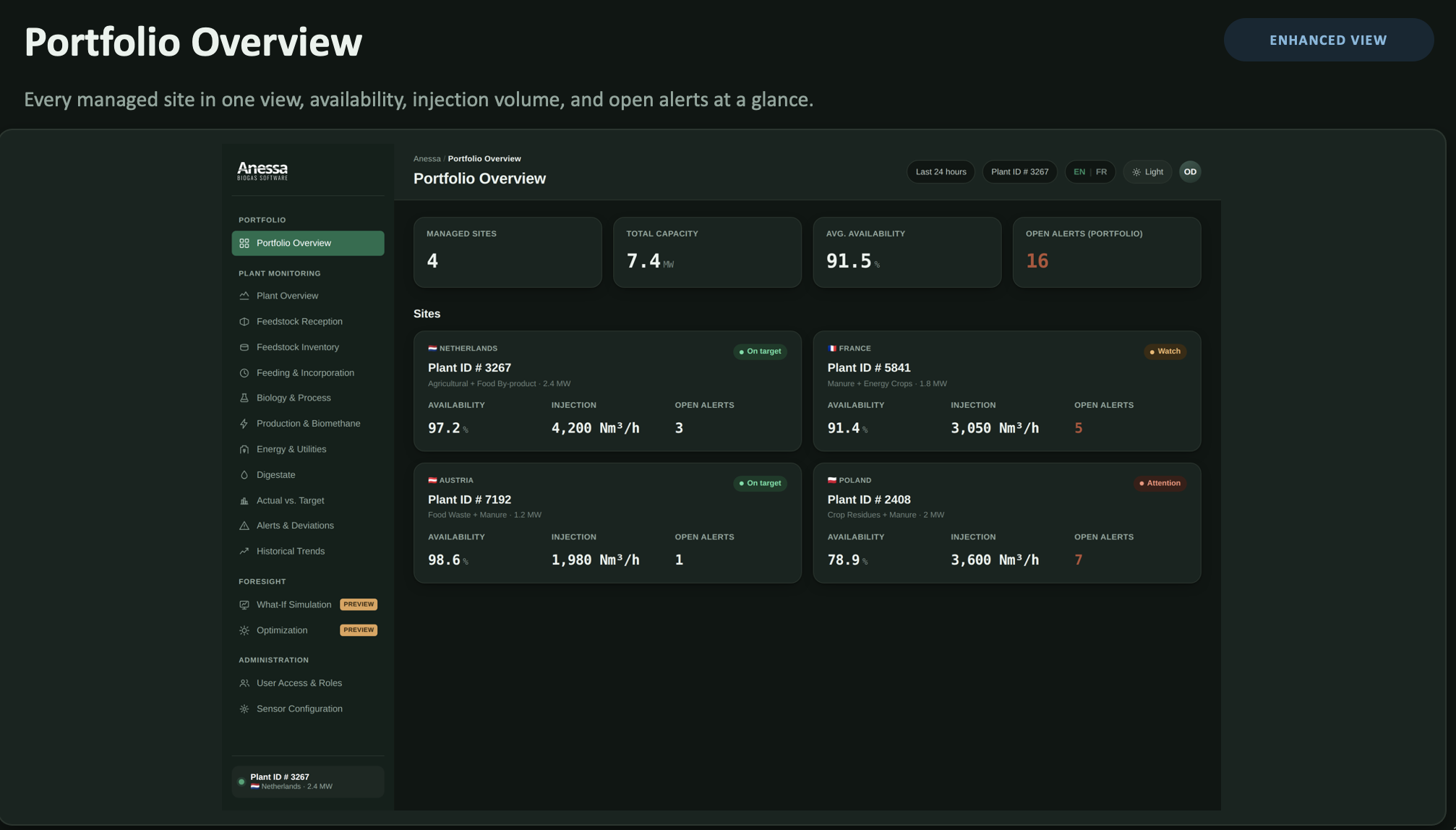
Anessa Suite: Portfolio Overview
Improving plant performance is no longer just about efficiency. It becomes a way to strengthen the overall financial position of the project.
Operational Transparency as a Commercial Advantage
One of the shifts happening in the RNG space is the growing importance of transparency.
Buyers and regulators are paying closer attention to how gas is produced, not just how much is delivered. Documentation, traceability and verifiable data are becoming essential parts of the equation.
For operators, this creates both pressure and opportunity.
Plants that can clearly demonstrate their performance have an advantage. When production data, emissions metrics, and operational records are well-documented and easy to validate, it reduces uncertainty for all stakeholders involved.
Transparency builds trust.
Anessa’s Stakeholder Views feature generates tailored reporting outputs for different audiences. Operators see real-time process data, investors see financial KPIs, and regulators or verifiers see compliance-ready documentation. The same underlying data serves all three, which is what makes it auditable rather than just presentable.
It allows buyers to feel confident in the reliability of supply. It gives investors a clearer view of asset performance. It also helps operators respond more effectively to audits, compliance requirements, and market changes.
In this context, operational data becomes more than just an internal tool. It becomes part of the plant’s commercial positioning.
Reducing Variability Before It Becomes a Problem
The challenge, of course, is managing variability before it affects contracts.
This is where a more proactive approach to operations starts to make a difference.
Instead of reacting to issues after they appear, operators can begin to identify patterns earlier.
For example:
Tracking how feedstock changes influence gas production and stability
Monitoring trends that could lead to quality deviations
Identifying early signs of process instability before they impact output
Understanding how operational adjustments affect carbon intensity performance
These insights allow for adjustments to be made in real time, rather than after the fact.
The Weighbridge integration captures exact incoming feedstock tonnages automatically, and ERP and CRM synchronization pulls biological characteristics and financial costs from supplier contracts. This means feedstock traceability is built into the system from the moment a delivery arrives, not reconstructed from paper records at reporting time
Over time, this leads to more stable production profiles and fewer surprises.
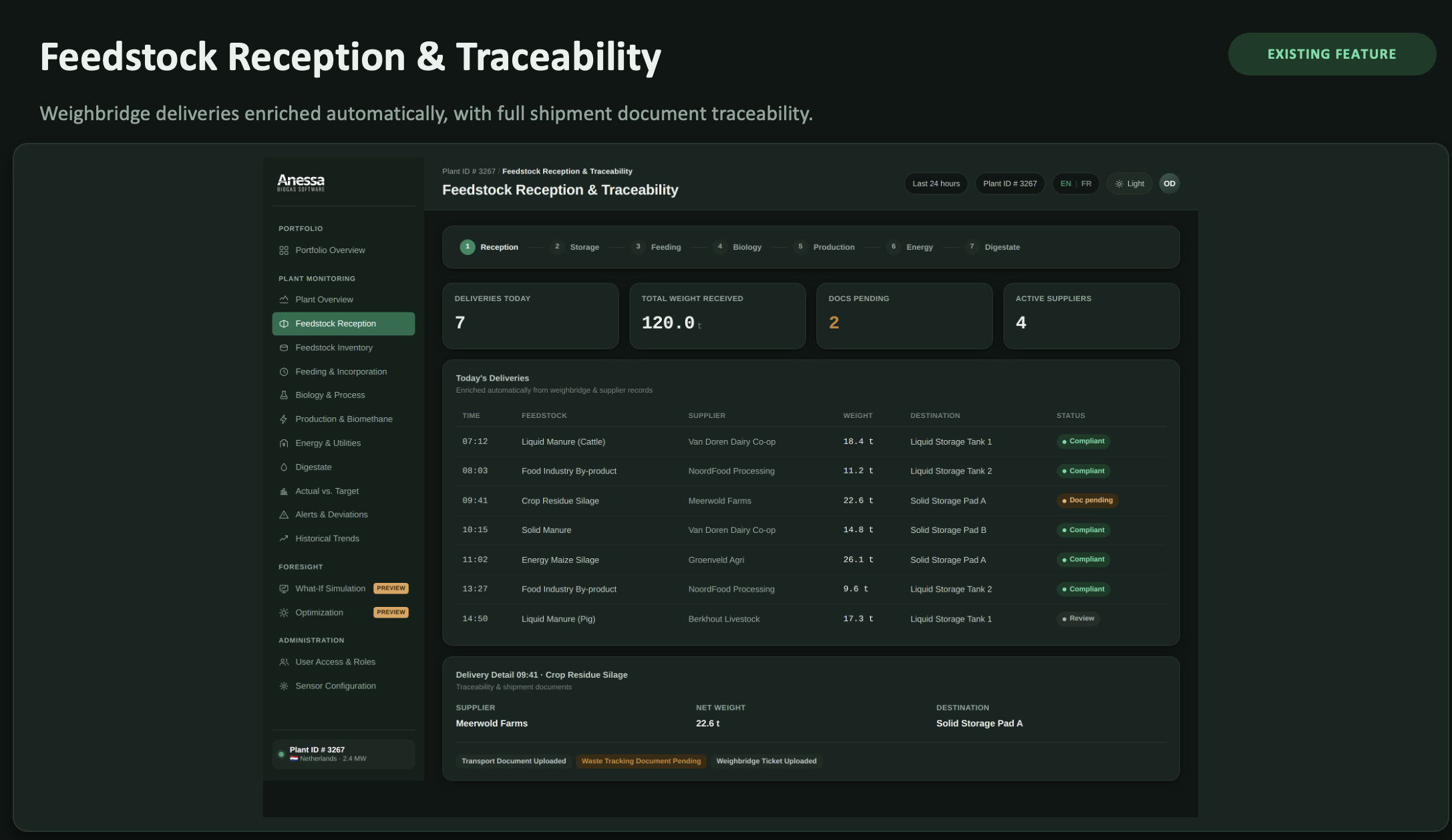
Feedstock Reception Dashboard
How Anessa Redefines Plant Analytics
Managing this level of consistency across a plant, or across multiple plants, requires more than manual oversight. It needs an analytics layer that converts the consistent stream of data into digestible, meaningful information. Data needs to be structured, accessible, and connected to decision-making.
This is where platforms like Anessa’s play a key role.
Anessa works as a financial digital twin for biogas, built on biology rather than surface-level data. The Suite starts with Simulation, which lets teams stress-test design choices and feedstock strategy before committing to a decision stream. Thus, reliability and stability get built in from day one.
Once the plant is running, Optimization takes over, modelling feedstock and operational scenarios to find the setup that actually holds up over the life of the offtake agreement.
Monitoring turns that modelling into a live read on the plant. Real operating data, tracked in real time, so deviations get caught before they become a problem.
Reporting brings it full circle by translating that work into the financial and compliance picture required by offtake partners.
Simply put, the Anessa Suite trades a handful of disconnected dashboards for one biogas plant spine that connects a design decision on paper directly to a number on a financial report.
This turns "hope offtake terms hold" into something you actually plan for.
Strengthening Contract Durability
Long-term contracts are built on trust, but that trust is supported by performance.
When a plant can demonstrate:
Predictable production over time
Stable and compliant gas quality
Clear and verifiable documentation
Consistent carbon intensity performance
It becomes easier to maintain and extend commercial relationships.
Contracts become more durable, and renegotiations become less about addressing risk and more about expanding opportunity. The budget vs. actual scenario analysis module gives operators a documented comparison of planned versus realized production, revenues, and energy consumption over any time period. In a contract renegotiation, that is a powerful commercial document. It shows buyers and investors exactly how the plant has performed against its original projections, not just what it is producing today.
Buyers are more willing to commit. Investors are more comfortable supporting growth. Operators gain flexibility in how they position their assets in the market.
All of this starts with operations.
Looking Ahead
As the RNG market continues to mature, expectations around reliability and transparency will continue to rise.
Buyers are becoming more sophisticated. Regulatory frameworks are evolving. Carbon markets are placing greater emphasis on data integrity and performance tracking.
In this environment, the gap between operational performance and commercial outcomes will continue to narrow. Plants that invest in stability, visibility and proactive decision-making will be better positioned to meet these expectations. Anessa has been utilized across many different biogas projects and the platform's ability to standardize operational data, reporting, and performance benchmarking across a portfolio is what makes it a bankable infrastructure choice, not just an operational tool.
These plants will also be better equipped to capture long-term value.
Offtake agreements are often seen as commercial milestones. They represent secured revenue, long-term partnerships and market validation.
But behind every strong contract is a well-run operation.
Consistency builds confidence.
Transparency builds trust.
Predictability strengthens value.
And over time, those qualities shape not just how a plant operates, but how it performs in the market.